The 👉👈 emoji combination is often used to express shyness, nervousness, cuteness, or hesitation in a text conversation. If you’re searching for the Meaning of This Emoji 👉👈, these pointing fingers commonly suggest that someone feels shy about asking a question, sharing a feeling, or expressing interest in another person.
In flirting and romantic conversations, this combination can create a cute, bashful tone, especially when someone wants to say something sweet but feels a little nervous. It can also be used jokingly between friends or to make a message seem playful and innocent.
However, its meaning depends on the conversation and the relationship between the people involved. In this guide, you’ll learn what 👉👈 means in texting, flirting, friendship, relationships, and social media, including what it may mean when a guy or girl sends it.
What Is the Basic Meaning of 👉👈?

The meaning of this emoji 👉👈 is commonly connected with shyness and awkwardness. People often use it when they want to appear timid, bashful, cute, or slightly nervous.
The visual idea behind 👉👈 is important. When the index fingers point toward each other, they can look like someone nervously moving their fingers together while avoiding direct eye contact.
For example:
“Can you stay and talk to me for a little longer? 👉👈”
Here, the emoji can make the request sound shy and sweet rather than demanding.
Another example is:
“I kinda missed you 👉👈”
In this case, 👉👈 can communicate embarrassment or nervousness about admitting a feeling.
Common meanings of 👉👈 include:
- Shyness
- Nervousness
- Awkwardness
- Embarrassment
- Cuteness
- Hesitation
- A soft request
- Playful flirting
- Wanting attention
- Feeling bashful
- Being unsure what to say
The exact meaning comes from the surrounding conversation.
👉👈 Meaning in Text Messages
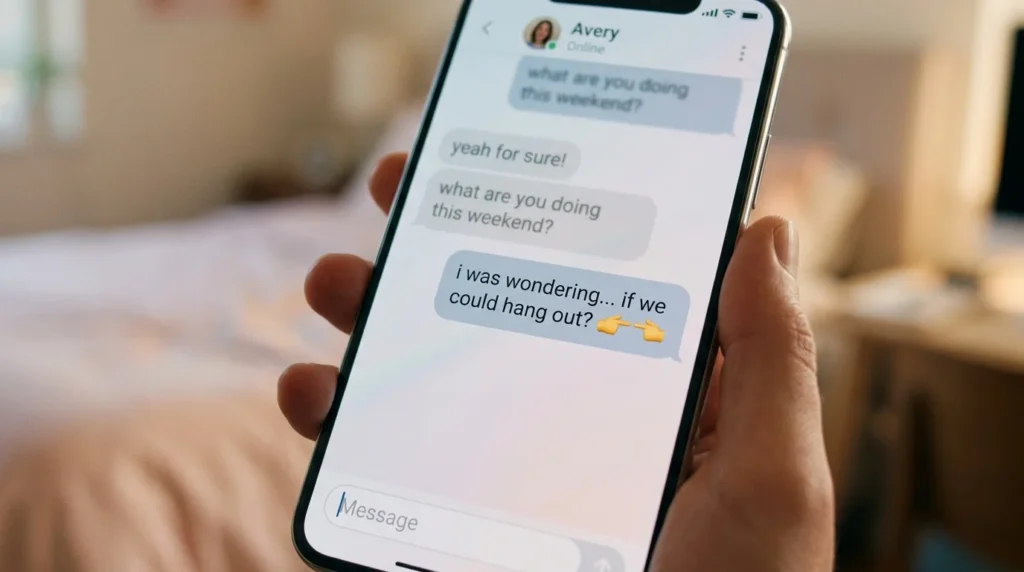
In texting, 👉👈 is often used to add an emotional tone to ordinary words.
Without an emoji, a sentence such as:
“Can you call me?”
may sound straightforward.
With 👉👈:
“Can you call me? 👉👈”
the same sentence may sound more shy, playful, or affectionate.
This is one reason people use emojis. They can change the emotional feeling of a sentence without changing the actual words.
Examples of 👉👈 in texting
“Can I ask you something? 👉👈”
This can suggest hesitation before asking a question.
“I want a hug 👉👈”
The emoji can make the request sound shy or cute.
“Do you maybe like me too? 👉👈”
Here, it may show nervousness about discussing romantic feelings.
“Can we talk later? 👉👈”
Depending on the conversation, this could sound gentle, hesitant, or slightly vulnerable.
👉👈 Meaning on Social Media
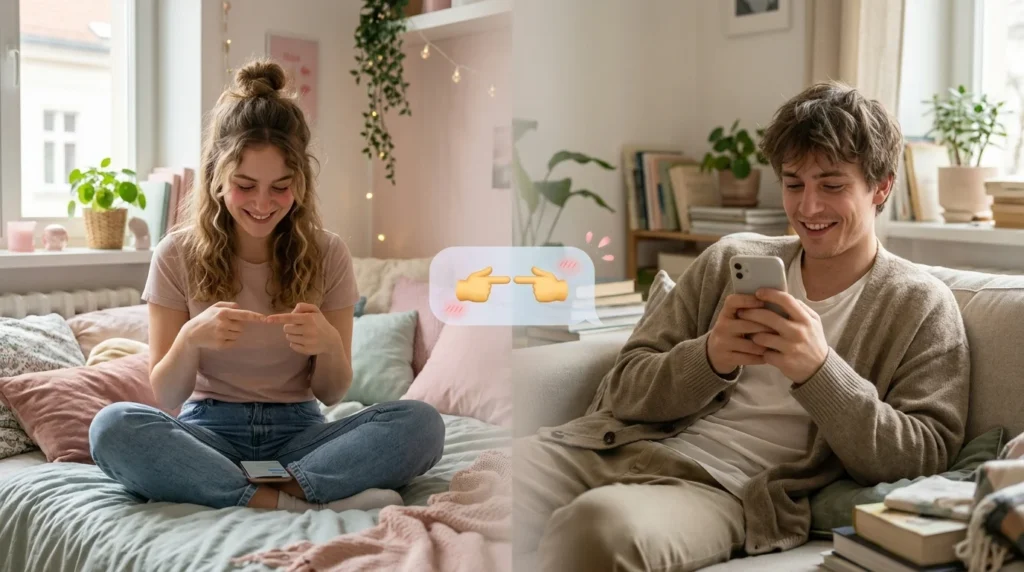
On social media, 👉👈 can have a playful or cute tone. People may use it in comments, captions, replies, memes, and direct messages.
For example, someone might comment:
“Can I have some too? 👉👈”
The emoji makes the request feel playful and less serious.
A person might also write:
“Okay but that outfit is actually so cute 👉👈”
Here, the emoji can add a bashful or playful tone.
On platforms where casual communication is common, 👉👈 may simply be part of someone’s personal texting style. Not every use indicates flirting.
👉👈 Meaning in Friendship
Between friends, 👉👈 often has a cute, playful, or joking meaning.
A friend might say:
“Can you bring me snacks tomorrow? 👉👈”
The emoji makes the request sound playful.
Another example:
“You didn’t forget my birthday, right? 👉👈”
This could be teasing rather than genuinely nervous.
Friends may also use 👉👈 when admitting something embarrassing:
“Okay… I may have eaten the last slice 👉👈”
In this situation, the emoji can communicate playful guilt.
So when a friend sends 👉👈, it does not automatically mean they are romantically interested.
👉👈 Meaning in Romantic Relationships
In a romantic relationship, 👉👈 can communicate affection, shyness, vulnerability, or playful intimacy.
For example:
“I want to see you tonight 👉👈”
The emoji can make the message sound softer and more affectionate.
Another example:
“I love when you say that 👉👈”
Here, it may suggest that the person feels a little shy about expressing their feelings.
Partners may also use 👉👈 during playful conversations:
“Can I steal one of your hoodies? 👉👈”
The meaning is generally understood through the relationship and the surrounding conversation.
👉👈 Meaning From a Girl
If a girl sends 👉👈, it can mean several different things.
She may be:
- Feeling shy
- Making a cute request
- Feeling embarrassed
- Being playful
- Nervous about asking something
- Flirting
- Trying to soften her words
- Looking for reassurance
For example:
“Do you wanna hang out sometime? 👉👈”
If the conversation already has romantic energy, the emoji could make the message feel shy or flirtatious.
But if she says:
“Can you send me the homework? 👉👈”
it is more likely to be a playful way of making a request.
The emoji alone is not enough to determine romantic interest.
👉👈 Meaning From a Guy
A guy may use 👉👈 in much the same way.
For example:
“Can I get a hug? 👉👈”
This may communicate shyness or affection.
Or:
“I kinda wanna talk to you 👉👈”
Depending on the relationship, this could be friendly, emotional, or romantic.
Some people naturally use cute or expressive emojis regardless of gender. Therefore, the fact that a guy sends 👉👈 does not automatically give it a romantic meaning.
👉👈 Meaning From a Crush
When a crush sends 👉👈, it can feel especially meaningful because the emoji is commonly associated with shyness and vulnerability.
Suppose your crush says:
“I was thinking about you today 👉👈”
The emoji may make the statement feel more bashful or affectionate.
Another example:
“Would you maybe want to go out with me? 👉👈”
Here, 👉👈 can reinforce the nervousness of asking someone on a date.
Still, context matters. Look at the complete conversation rather than interpreting the emoji by itself.
If the person regularly uses 👉👈 with everyone, it may simply be part of their communication style.
👉👈 Meaning From a Partner
When a partner uses 👉👈, it can express affection or playful vulnerability.
For example:
“Come here, I need a hug 👉👈”
or:
“I missed you today 👉👈”
In a relationship, the emoji can make emotional statements feel softer and more intimate.
It may also be used for playful requests:
“Can we order pizza tonight? 👉👈”
In this case, there may be no deeper emotional message at all.
Is 👉👈 a Flirting Emoji?
Sometimes, but not always.
👉👈 can be used while flirting because it can communicate shyness and nervousness. Someone may use it when they want to say something affectionate without sounding too direct.
For example:
“You look really good today 👉👈”
This could be flirtatious, especially if the conversation already has romantic energy.
However, the same emoji can appear in completely non-romantic situations.
For example:
“Can I have another cookie? 👉👈”
This is more likely to be playful than romantic.
So 👉👈 is not automatically a flirting emoji. The words, relationship, and conversation are more important than the emoji alone.
👉👈 Meaning When Someone Is Shy
One of the most common interpretations of 👉👈 is shyness.
Someone might use it when they want to admit something but feel nervous.
For example:
“I actually like your new profile picture 👉👈”
The emoji can suggest that the person feels slightly embarrassed about giving the compliment.
Another example:
“I kinda want to talk to you more 👉👈”
The emoji can communicate hesitation and emotional vulnerability.
👉👈 Meaning When Someone Is Asking for Something
The emoji is also frequently used to make a request sound softer.
Compare these:
“Send me the picture.”
and:
“Can you send me the picture? 👉👈”
The second version can feel less demanding and more playful.
Examples include:
- “Can you help me with this? 👉👈”
- “Can I borrow your charger? 👉👈”
- “Can you stay a little longer? 👉👈”
- “Can I have one too? 👉👈”
- “Will you text me later? 👉👈”
The emoji adds an emotional layer to the request.
👉👈 Meaning When Someone Feels Awkward
Sometimes 👉👈 simply means “This is awkward” or “I don’t know how to say this.”
For example:
“So… about yesterday 👉👈”
The person may be preparing to discuss something uncomfortable.
Similarly:
“I probably shouldn’t say this, but… 👉👈”
Here, the emoji can reinforce hesitation.
👉👈 Meaning in a Cute or Playful Way
Internet communication often uses 👉👈 as a cute expression.
Someone may use it intentionally to make a message sound innocent, bashful, or playful.
For example:
“I didn’t eat the last cookie… okay maybe I did 👉👈”
The emoji can turn the statement into a playful confession.
It can also be used jokingly:
“Can I have your fries? 👉👈”
The person may not actually be embarrassed. They could simply be using the emoji for humor.
👉👈 Meaning in a Sarcastic or Humorous Context
Not every use of 👉👈 is sincere.
People sometimes use it sarcastically to imitate a shy or innocent attitude.
For example:
“I accidentally bought another pair of shoes 👉👈”
The person might be joking about their spending.
Another example:
“I may have finished all the snacks 👉👈”
The emoji can create an exaggerated “Who, me?” feeling.
In these cases, the emoji’s meaning comes largely from the humor of the sentence.
Positive and Negative Interpretations of 👉👈
The emoji usually carries a relatively soft tone, but the interpretation can still change.
| Context | Possible meaning |
| Friendly chat | Playful or shy |
| Romantic chat | Affectionate or flirtatious |
| Asking a favor | Gentle request |
| Awkward conversation | Hesitation |
| Joke | Fake innocence |
| Emotional message | Vulnerability |
| Social media comment | Cute or playful reaction |
| Formal conversation | Usually unusual or inappropriate |
There is no universal rule that says 👉👈 must have one emotional meaning.
What Does 👉👈 Mean From a Crush?
If your crush sends 👉👈, you might wonder whether they are flirting.
It could indicate flirtation, especially when it appears with compliments, affectionate comments, or questions about dating.
For example:
“Would you want to go somewhere together this weekend? 👉👈”
That message has a clear romantic possibility because of the words surrounding the emoji.
However:
“Can you send me your notes? 👉👈”
does not necessarily indicate romantic interest.
The best way to understand the message is to consider the whole conversation and how the person normally communicates.
What Does 👉👈 Mean From a Friend?
From a friend, 👉👈 commonly means:
- “Please?”
- “I’m being shy.”
- “I’m joking.”
- “I’m embarrassed.”
- “Can you help me?”
- “Don’t judge me.”
- “I’m trying to be cute.”
For example:
Friend: “Can you bring me coffee? 👉👈”
You might understand this as a playful request.
Another friend could write:
“I forgot to do the assignment 👉👈”
Here, it could express embarrassment or humorous guilt.
How to Respond When Someone Sends 👉👈
Your response should depend on what the person said with the emoji.
If someone is making a simple request, you can respond naturally:
“Sure 😂”
or:
“Haha, okay.”
If the message seems shy or romantic, you can respond warmly:
“You don’t have to be shy with me 😊”
If you are interested in the person, you might reply:
“Aww, why are you being shy? 👀”
For a playful conversation:
“What are those fingers trying to say? 😂”
The best response usually matches the tone of the original message.
If a Friend Sends 👉👈
You can keep it casual:
“Haha, what do you want?”
or:
“Okay, tell me 😂”
If a Crush Sends 👉👈
If you want to encourage the conversation:
“You can just ask me 😊”
or:
“Why are you being shy? 😏”
If a Partner Sends 👉👈
You can respond affectionately:
“Come here ❤️”
or:
“Anything for you.”
If You Are Unsure What They Mean
The simplest response is:
“What do you mean? 😄”
There is nothing wrong with asking for clarification.
Examples of 👉👈 in Real Conversations
Example 1: Asking for a Favor
Person A: Can you help me with this question? 👉👈
Person B: Sure, send it over.
Here, 👉👈 makes the request feel shy and friendly.
Example 2: Romantic Conversation
Person A: I really like talking to you 👉👈
Person B: I like talking to you too.
The emoji can add nervousness and affection.
Example 3: Friendship
Person A: Can you save me some pizza? 👉👈
Person B: Maybe one slice 😂
This is playful rather than necessarily romantic.
Example 4: Embarrassment
Person A: Okay, I sent the message to the wrong person 👉👈
Person B: Oh no 😂
The emoji suggests embarrassment.
Example 5: Asking for Attention
Person A: Are you free to talk tonight? 👉👈
Person B: Yeah, what’s up?
Here, the emoji can make the question sound more hesitant or emotionally vulnerable.
Example 6: Playful Confession
Person A: I may have eaten your chocolate 👉👈
Person B: You did WHAT? 😂
The emoji creates a jokingly innocent tone.
Similar Emojis and How They Differ
Several emojis can appear in similar situations, but they communicate different emotional signals.
| Emoji | Common feeling |
| 👉👈 | Shy, hesitant, awkward, cute |
| 🥺 | Pleading, emotional, wanting sympathy |
| 🥹 | Emotional, touched, overwhelmed |
| 😊 | Warm, happy, friendly |
| 😳 | Embarrassed, surprised, flustered |
| 😅 | Nervous, embarrassed, relieved |
| 🫣 | Shy, hiding, embarrassed |
| 🙈 | Embarrassment or “I don’t want to see this” |
| 👀 | Curiosity, interest, watching |
👉👈 vs 🥺
Both can appear in requests, but they have different tones.
👉👈 often feels shy or bashful, while 🥺 can feel more pleading or emotionally vulnerable.
For example:
“Can I have some? 👉👈”
sounds shy and playful.
“Please can I have some? 🥺”
sounds more like a plea.
👉👈 vs 😳
😳 generally communicates surprise, embarrassment, or being flustered.
👉👈 often communicates a quieter form of shyness or hesitation.
They can also appear together:
“You actually said that to me 😳👉👈”
This could communicate being flustered and shy at the same time.
👉👈 vs 🫣
🫣 has a stronger “hiding because I’m embarrassed” feeling.
👉👈 can be more gentle and playful.
Common Misunderstandings About 👉👈
1. 👉👈 Always Means Flirting
This is one of the biggest misunderstandings.
The emoji can be flirtatious, but it is also used between friends, family members, online communities, and casual acquaintances.
2. 👉👈 Has One Official Emotional Meaning
Emoji interpretation is flexible. People use emojis differently depending on their personality, age group, culture, online community, and communication habits.
3. 👉👈 Always Means Someone Is Nervous
Nervousness is a common interpretation, but people may also use it simply because they think the emoji looks cute.
4. It Always Has a Deep Hidden Message
Sometimes an emoji is just an emoji.
If someone writes:
“Can you pass the salt? 👉👈”
there may be no hidden emotional meaning.
5. You Can Understand the Message From the Emoji Alone
The surrounding words are extremely important.
“Miss you 👉👈” and “Send me the notes 👉👈” may use the same emoji but communicate very different things.
Why Do People Use 👉👈?
People use 👉👈 because emojis make digital conversations more expressive.
Text does not naturally show facial expressions, gestures, body language, or voice tone. An emoji can help fill some of that gap.
👉👈 can make a message appear:
- Softer
- Shyer
- More playful
- More affectionate
- Less demanding
- More humorous
- More vulnerable
It can also help someone communicate an emotion without directly describing it.
Instead of saying:
“I’m feeling shy about asking you this.”
someone might simply write:
“Can I ask you something? 👉👈”
Does 👉👈 Mean “Please”?
Sometimes.
When attached to a request, 👉👈 can work like a playful version of “please.”
For example:
“Can you give me one? 👉👈”
The emoji may communicate:
“Please? I’m asking nicely.”
But 👉👈 does not literally translate to the word “please.” Its meaning depends on the message.
Does 👉👈 Mean “I’m Shy”?
It can.
If someone sends:
“I wanted to tell you something 👉👈”
they may be communicating shyness or hesitation.
However, this is an interpretation rather than a fixed translation. The same emoji can be used humorously or casually.
Can 👉👈 Be Used in a Romantic Message?
Yes.
It can work especially well when someone wants to communicate affection while keeping the tone soft.
Examples include:
“I wish you were here 👉👈”
“Can I get a hug? 👉👈”
“I really like you 👉👈”
These messages can sound shy or vulnerable.
Still, the emoji does not prove romantic intent by itself.
Can 👉👈 Be Used in a Professional Message?
It is possible, but it is usually better suited to informal communication.
In a professional email, for example, 👉👈 could look too casual or playful.
In a workplace chat between close colleagues, the meaning may be understood differently, but the communication style and workplace culture matter.
Does Culture Affect the Meaning of 👉👈?
Yes.
Emoji use can vary between online communities, age groups, regions, and cultures.
Some people may interpret 👉👈 as cute and shy. Others may see it as humorous internet language. Someone who rarely uses emojis may interpret it differently from a person who uses emojis in almost every message.
This is why context is especially important when interpreting emojis.
How to Know What 👉👈 Really Means
If you receive 👉👈 and are unsure what the sender means, look at several things.
Look at the Words
Read the complete message rather than focusing only on the emoji.
Look at Your Relationship
A message from a best friend may have a different meaning from the same message sent by a romantic partner.
Look at the Conversation Before It
Previous messages can provide important clues.
Consider Their Normal Style
Does the person use 👉👈 frequently? If they send it to everyone, it may not carry a special meaning.
Look at Other Emojis
👉👈 combined with ❤️, 😳, 🥺, 😏, or other emojis can create a different tone.
Ask if Necessary
When the meaning is genuinely unclear, asking is better than making a strong assumption.
Final Thoughts on the Meaning of This Emoji 👉👈
The meaning of this emoji 👉👈 is most commonly associated with shyness, hesitation, awkwardness, embarrassment, cuteness, or a playful request. It can also appear in flirting and romantic conversations, especially when someone feels nervous about expressing affection.
However, 👉👈 does not have one fixed meaning. A friend may use it to make a request sound cute, a crush may use it while flirting, a partner may use it affectionately, and someone else may use it simply as a joke.
The most reliable way to understand 👉👈 is to consider the words around it, the relationship between the people, the previous conversation, and the sender’s usual communication style. When those factors are considered together, the intended tone is usually much easier to understand.
FAQs About the Meaning of This Emoji 👉👈
1. What is the meaning of this emoji 👉👈?
The meaning of this emoji 👉👈 is commonly connected with shyness, hesitation, awkwardness, embarrassment, cuteness, or playful requests. The exact interpretation depends on the conversation and relationship.
2. Does 👉👈 mean shy?
Yes, 👉👈 can mean that someone feels shy or nervous. People often use it when they want to say something but feel a little embarrassed or hesitant.
3. Does 👉👈 mean flirting?
It can be used for flirting, especially when combined with romantic or affectionate words. However, 👉👈 does not automatically mean someone is flirting.
4. What does 👉👈 mean from a girl?
From a girl, 👉👈 can express shyness, playfulness, embarrassment, affection, hesitation, or a soft request. The emoji alone cannot confirm romantic interest.
5. What does 👉👈 mean from a guy?
A guy may use 👉👈 to show shyness, awkwardness, affection, humor, or a playful request. Its meaning depends on what he says and the relationship between you.
6. What does 👉👈 mean from a crush?
From a crush, 👉👈 may suggest nervousness or playful flirting, particularly when used with compliments or romantic statements. However, the surrounding conversation should be considered before interpreting it as romantic interest.
7. How should I respond to 👉👈?
Respond according to the message. If it is a friendly request, keep your reply casual. If it seems romantic, you can respond warmly or playfully. You are unsure, simply ask what they mean.
8. Is 👉👈 a cute emoji?
Many people use 👉👈 as a cute or bashful emoji. Its finger-pointing appearance is often used to create a shy, playful, or slightly awkward tone.

I’m James Carter, and I believe the right words can change the game.
I share creative, funny, and confident pickup lines designed to help you break the ice, start conversations, and make a strong first impression.